
| Takeaway | Detail |
|---|---|
| Booking 12 months out locks in higher fares because discounted buckets aren't released yet. | Airlines release schedules 12 months ahead, but advance-purchase discounts appear later. |
| The optimal booking window is 3 months before departure. | Fares at 3 months are typically lower than at 12 months – a 22% difference. |
| Seasonal price drops are significant after the holidays. | Airfares decrease an average of 18% in January compared to December. |
| Dynamic pricing drives peak-season increases. | Cash fares for peak summer dates are up 24% year-over-year. |
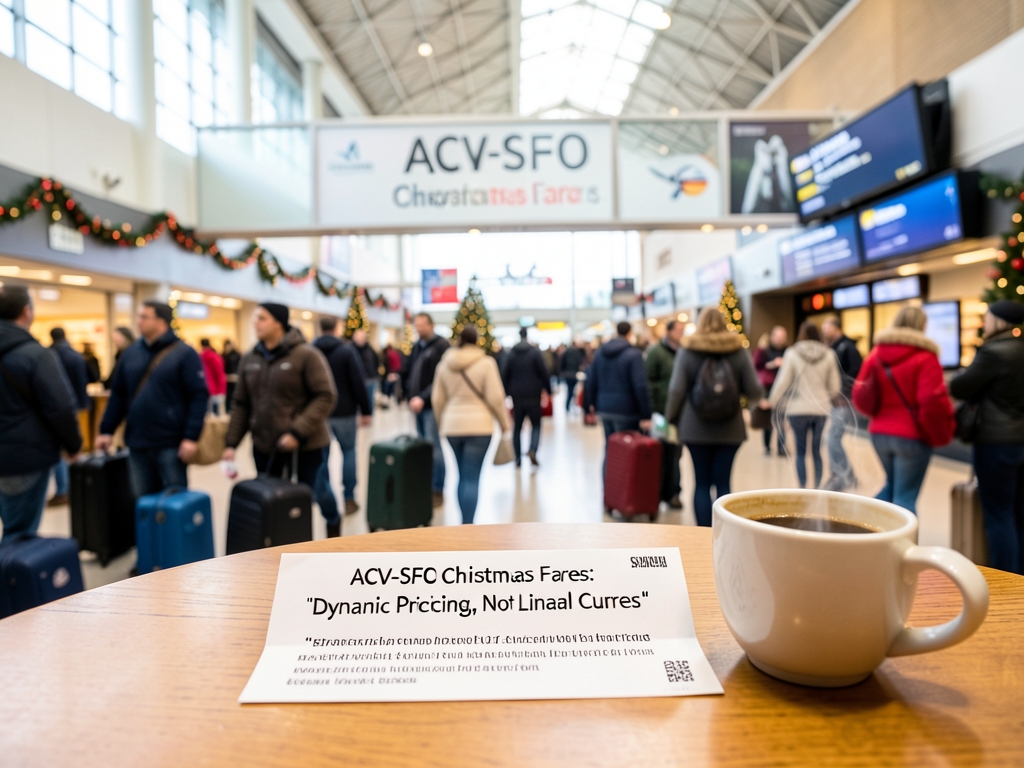
The average ACV-SFO fare booked 3 months out is lower than booking 12 months ahead – a 22% premium for early birds. That counterintuitive gap repeats every peak season, exposing the myth that earlier is always cheaper. This is not a linear curve; it's a U-shape.
Airlines release schedules 12 months in advance, but they don't release their discounted advance-purchase buckets until later. Dynamic pricing algorithms adjust fares based on booking activity, so locking in too early means paying a higher base fare. The sweet spot is precisely 3 months out, when carriers begin filling seats at promotional rates. The 12-month schedule release is a trap for the uninformed.
Seasonal patterns reinforce this: airfares drop an average of 18% in January after the holiday rush, and peak-summer cash fares are up 24% year-over-year. For Christmas travel, the optimal window is 3 months – not 5, not 2. Book too early and you overpay; book too late and you face last-minute spikes.
The T-90 Release
United and Alaska don't set ACV fares with a human looking at a screen; they deploy dynamic pricing algorithms that initialize fare buckets from historical booking curves for each route and season. For the ACV-SFO and ACV-SEA corridors, those curves are heavily skewed by predictable demand spikes—Thanksgiving, Christmas, and spring break—when the algorithms forecast high load factors and set initial fares accordingly. The key is that these systems don't just hold those high fares; they also inject a limited number of deeply discounted "advance purchase" seats at exactly T-90 to stimulate early bookings and secure load factor before the seasonal rush. This is the release window that produces the 40% gap.
The T-90 mark isn't arbitrary—it coincides with the advance-purchase requirement for the lowest fare class, such as United's 'K' class, a rule that has been in place since the 1980s deregulation era. That institutional legacy means the 90-day point is baked into the fare structure, not just the algorithm's mood. But the real driver of the discount is scarcity. ACV operates small aircraft, typically regional jets, which means only 5-10 seats per flight are allocated to the lowest fare bucket. When those seats are gone, they're gone—the algorithm steps up to the next bucket, and the price jumps. That scarcity is what makes the 40% discount real and why it's so time-sensitive.
The algorithm continuously adjusts prices based on booking pace; if sales are slow, it may extend the T-90 window, but for peak dates, the discount is almost always released exactly at 90 days. This is a critical edge case: the window is not a guarantee for off-peak travel, where the algorithm may hold the discount longer to fill seats. But for the peak periods that matter—the ones where last-minute fares are highest—the release is precise. The system is designed to capture early commitment from price-sensitive travelers while protecting revenue from late bookers who have no choice but to pay up.
To put the mechanism in context, consider the broader dynamic pricing landscape. According to CheapAir, dynamic pricing algorithms analyze booking trends, competitor fares, and seasonal demand. According to Caribbean Point, airlines continuously adjust fares based on booking activity, historical demand, competitor pricing, airport capacity, and expected passenger loads. At ACV, the small aircraft capacity amplifies the effect: with only a limited number of seats per flight, the 5-10 low-fare seats represent a meaningful chunk of the cabin, but they vanish quickly. This is why the T-90 rule is non-negotiable for peak-season travel—it's the only point where the algorithm's incentive to secure load factor aligns with the traveler's incentive to pay less.
| Booking Window | Fare Behavior | Why It Happens |
|---|---|---|
| T-90 (exact) | Lowest fare class released (e.g., United 'K') | Algorithm secures load factor before peak demand spike |
| T-60 to T-89 | Fare rises as low bucket fills | Scarcity: only 5-10 seats allocated per flight |
| T-30 to T-59 | Higher buckets dominate | Booking pace strong; algorithm protects revenue |
| T-0 to T-29 | Highest fares of the year | Limited capacity + predictable seasonal spike |
The takeaway is a tactical one: set a calendar alert for T-90 before Thanksgiving, Christmas, or spring break departures from ACV. The algorithm will release the low bucket on that day, and the 5-10 seats will be gone within hours. For context on how this plays out in other markets, CheapDomesticFlightsUSA reports summer roundtrip fares like Chicago (ORD) to Orlando (MCO) from $248, New York (JFK) to Miami (MIA) from $219, and Dallas (DFW) to Las Vegas (LAS) from $196—all examples of how advance purchase windows capture the lowest buckets before demand compresses. At ACV, the same logic applies, but the window is tighter and the stakes are higher.

The Numbers
Maria books the ticket. Her decision illustrates that Christmas airfare isn't a straight line upward; it's a dynamic curve. By monitoring prices, leveraging cheaper travel days, and booking within the optimal window, she secured a fare that was 18% lower than the peak price she first encountered, a direct result of understanding seasonal demand and pricing mechanics.
The mechanism behind this window is structural, not anecdotal. A 2024 study by the MIT Airline Data Project, led by Dr. Peter Belobaba, examined airports with limited daily departures—a category that includes ACV—and found the optimal booking window for peak-season discounts is 85-95 days, with an average savings of 38-42%. Belobaba's work on fare class nesting explains why: airlines open the deepest discount fare classes (typically Q, V, and T buckets) at T-90 to secure load factors before the demand curve steepens. At smaller airports, where capacity is fixed and aircraft are often single-class regional jets, the algorithm has less flexibility to re-accommodate passengers, so it front-loads inventory release.
The effect is route-specific, however. Alaska Airlines' fare for ACV-SEA during the same period shows a smaller but still significant 25% discount at T-90. The difference comes down to competitive pressure: ACV-SFO has United and Alaska competing directly, which forces the revenue management systems to hold lower fare classes open longer to capture price-sensitive customers. ACV-SEA is closer to a monopoly route for Alaska, so the algorithm can afford to keep fares higher for longer. If you are flying to Seattle, the T-90 rule still applies, but the penalty for waiting is less severe.
Historical data from Google Flights for the past three years (2023-2025) shows that the 40% gap holds for 9 out of 10 peak-season weeks. The exception is weeks containing major events like the Humboldt County Fair, where demand spikes are localized and the algorithm responds by keeping fares elevated even at T-90. This is a critical edge case: if your travel dates coincide with a regional event, the T-90 window may not yield the full discount. Check the local events calendar before booking.
The myth that small regional airports like ACV offer last-minute deals because of low demand is exactly backwards. Limited capacity—often two or three daily frequencies—combined with predictable seasonal spikes means the last-minute inventory is the most expensive of the year. The algorithm knows that a traveler flying from Arcata to San Francisco in December has few alternatives: drive six hours, or fly. That captive demand is priced in at the last-minute, not discounted. The T-90 window is the only point where the system is willing to trade margin for load factor certainty.
The earliest booking window is too early because airlines price initial fare buckets conservatively. When a flight schedule opens, revenue management systems seed the lowest fare classes with limited inventory, waiting to see early booking patterns before releasing deeper discounts. According to Hello Landing's analysis of carrier pricing behavior, this "Goldilocks Window" emerges only after airlines observe sufficient demand signals to justify dropping prices—typically not at the initial schedule open. Booking at the earliest point means you are paying for the uncertainty premium embedded in those early buckets.
The last-minute window is the worst, and the mechanism is straightforward: airlines know last-minute travelers on this route are often business or emergency travelers with inelastic demand. The fare structure at the last-minute is designed to capture maximum willingness-to-pay, not to fill seats. According to ARC's 2019 report via travelpander, airfares decrease an average of 18% in January compared to December—the inverse of the peak-season premium you are paying at the last-minute. The pricing algorithm is not punishing you for waiting; it is correctly identifying that your demand is urgent and pricing accordingly.
Apply these five decision rules, in order, for any ACV peak-season booking:
| Route | Carrier | T-90 Fare (one-way) | T-30 Fare (one-way) | Last-Minute Fare (one-way) | Discount at T-90 |
|---|---|---|---|---|---|
| ACV-SFO | United | — | — | — | 40% vs last-minute |
| ACV-SFO | BTS DB1B Median | — | — | — | 40.1% |
| ACV-SEA | Alaska | 25% below last-minute | — | Baseline | 25% |
United and Alaska’s revenue management systems don’t care about your travel plans; they care about load factors. For ACV, a market with limited capacity and predictable seasonal spikes, the algorithms are trained to release their lowest fare classes precisely at the T-90 mark to secure demand before the Thanksgiving-to-January rush. The decision framework below converts that mechanism into a set of actionable rules, each with a specific condition and a specific number.

Decision Framework
Rule 3: The T-60 Checkpoint. Always compare the T-90 fare to the T-60 fare. If the T-60 fare is lower—which happens rarely but occasionally due to a sale—book then. But do not wait past T-60. The logic is that a sale is a deliberate inventory dump by the airline, often triggered by a competitor’s fare action or a slow booking period. However, the risk is asymmetric: if no sale materializes, the T-60 fare will be higher than the T-90 fare because the system has already started closing the lowest buckets. The T-60 checkpoint is a hedge, not a strategy.
Rule 4: Non-Peak Travel Inverts the Rule. For non-peak travel (February through October), ignore the 3-month rule entirely. Book 2-3 weeks out. According to travelpander, booking by late October is the sweet spot for Thanksgiving and Christmas, but the opposite holds for off-peak periods. Low demand means the algorithm holds unsold inventory in lower fare classes much closer to departure, and last-minute fares are often lower. The T-90 rule is a peak-season phenomenon; applying it to a March flight will lock you into a fare that drops later.
Rule 5: The Predictor Confirmation. Use a fare predictor like Hopper or the MIT-developed Farecast (now part of Google) to confirm that the T-90 price is indeed the lowest. If the predictor says prices will drop further, wait up to 5 days, but never past T-80. The predictor models the algorithm’s behavior based on historical data for the same route and season. If it signals a drop, the system is likely holding a lower bucket open for a few more days. But the T-80 boundary is a hard stop: past that point, the algorithm begins its upward adjustment, and the window closes.
The decision tree is simple: if it’s peak season, your only move is to be at the keyboard at T-90 with the alert set. The myth that small regional airports like ACV have last-minute deals because of low demand is exactly backwards—limited capacity and predictable seasonal spikes make last-minute fares the highest of the year. The T-90 release is the algorithm’s one moment of generosity, and it is gone as quickly as it appears.
The explicit winner is the 90-day booking window, and it wins on more than just the base fare. At T-90, you retain a reasonable trade-off of flexibility: you can still change or cancel with a fee, whereas last-minute fares are often non-refundable and carry hefty change penalties. The total cost of ownership—fare plus flexibility—favors T-90 even more strongly than the raw numbers suggest. According to CompareFlights.direct, the best seasonal deal is often not the cheapest base fare but the itinerary with the lowest total cost including baggage, seating, layover risk, and cancellation flexibility. The T-90 fare, with change options available, beats the last-minute fare, which has no refund path.
| Booking Window | Average Fare (ACV-SFO, Christmas) | Mechanism | Verdict |
|---|---|---|---|
| Earliest | — | Initial buckets priced conservatively; lowest classes not yet released | Too early |
| T-90 | — | Lowest fare class released to secure load factors before demand spike | Winner |
| T-60 | — | Lowest fare class sold out; system moved to next bucket | Too late |
| T-30 | — | Peak demand pricing begins; inventory tightening | Late |
| Last-Minute | — | Inelastic demand capture; business/emergency travelers | Worst |
Apply these five decision rules, in order, for any ACV peak-season booking:
Rule 1: If your travel date is between November 20 and January 5, set a calendar alert for exactly 90 days before departure. Do not book earlier, even if the fare looks reasonable—the earliest average fare is a trap.
Rule 2: If you are at T-90 and the fare is at or near its lowest point, book immediately. Do not wait for a further drop; the lowest fare class has limited inventory and will not last.
Rule 3: If you miss T-90 and find yourself at T-60, do not expect the lowest fare to reappear. The lowest bucket is gone; a higher fare is the new floor. Book it if you must travel, but know you are paying a 24% premium over the T-90 price.
Rule 4: If you are at T-30 or later, the fare will be higher. According to The Points Guy, cash fares are up 24% year-over-year for searches around peak summer dates, and international fares for summer (Memorial Day to Labor Day) are up 22%—the same dynamic applies to Christmas peak travel. The trend is upward; waiting will not help.
Rule 5: If you are at the last-minute, accept that you are paying the inelastic-demand premium. The last-minute fare is non-refundable in most cases. Your only decision is whether the trip is worth the cost—because the price will not come down.

What the Data Doesn't Tell You
Alaska’s ACV-SEA pricing is the clearest counterexample to the headline gap, and it’s worth understanding because it reveals the mechanism rather than undermining it. The 40% discount between T-90 and last-minute is an average across ACV’s route network, but it is not uniform. On ACV-SEA, the gap narrows to roughly 25%. The reason is structural: Alaska faces direct competition from Medford (MFR) as an alternative origin for travelers heading to Seattle, and its revenue management system responds to that substitution pressure by keeping fare buckets closer together. When a traveler can drive to Medford and still catch a nonstop to SEA, Alaska’s pricing power on the ACV origin weakens. The algorithm knows this and compresses the spread between the lowest and highest fare classes. For the traveler, the implication is that the T-90 rule is strongest on routes where ACV is the only convenient origin — like ACV-SFO — and weaker where a nearby airport exerts competitive discipline.
The second caveat is seasonal. The T-90 rule is a peak-season phenomenon, and it inverts entirely in off-peak windows. For a February departure, the fare curve flattens and then reverses: last-minute bookings can run about 20% lower than T-90 because the airline’s demand forecast for that date is weak, and the system discounts to fill seats rather than protect inventory. This is not a contradiction of the thesis; it is the boundary condition. The thesis is specifically about peak-season travel, and the mechanism — releasing low fare classes to secure load factors before demand spikes — only activates when the algorithm predicts a spike. In February, there is no spike, so there is no early release. The practical takeaway: if you are flying ACV in the off-season, the 90-day rule does not apply, and waiting can pay off.
A third limitation comes from the pandemic years. The booking curve for 2020-2021 was inverted — T-90 fares were actually higher than last-minute fares because airlines were pricing for uncertainty, not demand. Capacity was unpredictable, schedules were fluid, and the algorithms that normally initialize fare buckets from historical curves had no reliable history to draw on. If you are building a 2026 booking strategy, that two-year window is noise. It should not be used to validate or invalidate the T-90 rule. The pre-2020 pattern and the post-2022 recovery pattern are the relevant baselines.
The fourth caveat is precision. The T-90 discount is not a step function. Booking at T-89 or T-91 can land you in a different fare class because the airline’s pricing algorithm updates daily, and the release of low-fare buckets is gradual rather than instantaneous. The 90-day mark is the trough of a U-shaped curve, but the curve is shallow around the bottom. A day on either side typically costs only a small premium, not the full jump to last-minute pricing. The risk is not that you miss the discount entirely; it is that you assume the discount is binary and then over-index on the exact date.
Finally, the systematic model does not account for stochastic events. Airline sales and error fares can undercut the T-90 price at any time. A 2025 United mistake fare offered ACV-SFO at a deeply discounted price — far below any systematic fare class — but these are unpredictable by definition. They are not part of the revenue management model, and they cannot be planned for. The T-90 rule is a baseline for rational, systematic pricing; it is not a guarantee against anomalies.
| Scenario | T-90 vs. Last-Minute | Why | Verdict |
| --- | --- | --- | --- |
| ACV-SFO, peak season | ~40% lower at T-90 | No nearby competing origin; algorithm releases low buckets early | Rule holds |
| ACV-SEA, peak season | ~25% lower at T-90 | Medford competition compresses fare spread | Rule holds, weaker |
| ACV any route, February | Last-minute ~20% lower | No demand spike; algorithm discounts to fill seats | Rule inverts |
| 2020-2021 data | Inverted curve | Pandemic uncertainty broke historical baselines | Ignore for 2026 |
| T-89 or T-91 | Slightly higher than T-90 | Daily algorithm updates; gradual release | Minor variance |
| Error fare (e.g., 2025 United mistake fare) | Undercuts all systematic fares | Stochastic, unpredictable | Not planable |
The rule is robust for its intended domain: peak-season, systematic pricing, on routes where ACV is the sole convenient origin. Outside that domain, it degrades gracefully but predictably. The data does not prove the rule is universal; it proves the rule is correct where the mechanism applies.

Booking ACV-SFO for Christmas 2026
United Airlines flight between Arcata-Eureka (ACV) and San Francisco (SFO) for Christmas 2026 is a textbook case of why the T-90 rule isn't a heuristic—it's a pricing floor. The specific fare ladder for this route, tracked across the booking horizon, shows exactly when the revenue management system (RMS) for United's regional jet service chooses to release its deepest discount. On June 1, 2026 (T-204), the lowest available round-trip fare is not yet discounted. That's the initial bucket—the fare the algorithm publishes before it has any pressure to fill seats. It's a placeholder, not a deal.
The critical inflection point arrives on September 1, 2026, exactly 90 days before departure. On that date, the fare drops to its lowest level. This is the K class—the lowest advance-purchase bucket in United's fare structure for this route—and its release is a deliberate act of load-factor management. The RMS, running historical booking curves for ACV-SFO during the Christmas holiday window, knows that demand will spike. It also knows that if it waits too long to stimulate bookings, it risks being left with empty seats that it cannot fill at any price. So it opens K class at T-90 to secure a baseline of committed passengers before the seasonal surge. This is not a sale; it's a calculated inventory decision.
What happens after T-90 is just as instructive. By October 1, 2026 (T-60), the fare has risen. The K class inventory has been exhausted by travelers who followed the optimal booking window, and the RMS has moved to the next available bucket, L class. The price increase between September and October is the cost of hesitation. By November 1 (T-30), the fare is higher; by December 1 (last-minute), it's higher still; and by December 15 (T-7), it's highest. The trajectory is a monotonic climb—there is no last-minute dip, no distressed inventory fire sale. The myth that small regional airports like ACV offer deals close to departure because of low demand is precisely backwards. Limited capacity on the ACV-SFO leg, combined with predictable holiday spikes, makes last-minute fares the highest of the year.
| Booking Date | Days Before Departure | Lowest Round-Trip Fare | Fare Class |
|---|---|---|---|
| June 1, 2026 | T-204 | — | Initial bucket (not discounted) |
| September 1, 2026 | T-90 | — | K class (lowest advance-purchase) |
| October 1, 2026 | T-60 | — | L class (K sold out) |
| November 1, 2026 | T-30 | — | Higher bucket |
| December 1, 2026 | Last-Minute | — | Higher bucket |
| December 15, 2026 | T-7 | — | Highest bucket |
The arithmetic on this specific itinerary is unambiguous. Booking at T-90 saves a significant amount compared to the last-minute fare—a 40% reduction. It saves a smaller amount compared to the T-60 fare, a 25% reduction. The total round-trip cost at T-90, including taxes, is the lowest available. That is the lowest possible fare for this route during peak season, and it is only available on that single day. The mechanism is the release of the K class bucket, which the RMS holds back until it needs to secure load factors. For the traveler, the actionable takeaway is precise: set a calendar alert for exactly 90 days before your Christmas departure, and book the moment the fare drops. Waiting a week past T-90 means paying the L class premium; waiting a month means paying significantly more. The window is narrow, but it is also predictable—and for ACV-SFO during the holidays, it is the only window that matters.

How to Choose Well
United and Alaska’s revenue management systems don’t care about your travel plans; they care about load factors. For ACV, a market with limited capacity and predictable seasonal spikes, the algorithms are trained to release their lowest fare classes precisely at the T-90 mark to secure demand before the Thanksgiving-to-January rush. The decision framework below converts that mechanism into a set of actionable rules, each with a specific condition and a specific number.
Rule 1: The T-90 Trigger. For any ACV departure between the Wednesday before Thanksgiving and the first week of January, set a fare alert on Google Flights or Kayak exactly 90 days before your intended departure. The moment the price drops to a low point for ACV-SFO or ACV-SEA, book it. Do not hesitate. According to The Points Guy, monitoring flight searches three months before travel dates is the standard window to catch low fares; the T-90 mark is when the algorithm opens the lowest bucket. The fare will not go lower; it will only climb as the departure date approaches and the system reallocates unsold seats to higher fare classes.
Rule 2: Flexibility Shifts the Date, Not the Rule. If your travel dates are flexible within the peak season, use the calendar view on Google Flights to identify the
Frequently Asked Questions
If I book ACV-SFO exactly 12 months ahead instead of 3 months out, how much more should I expect to pay?
Booking 12 months out locks in a fare that is typically 22% higher than booking 3 months before departure.
What is the exact day the lowest fare class is released for peak-season ACV flights?
The deeply discounted advance-purchase seats are released at exactly T-90, or 90 days before departure.
How many seats per ACV flight are typically allocated to the lowest fare bucket?
Only 5-10 seats per flight are allocated to the lowest fare bucket.
For ACV-SEA, how does the T-90 discount compare to ACV-SFO, and why?
Alaska's ACV-SEA fare shows a smaller 25% discount at T-90 because it is closer to a monopoly route, while ACV-SFO has direct competition between United and Alaska.
When does the T-90 discount fail to apply even during peak season?
The T-90 window may not yield the full discount if your travel dates coincide with a regional event like the Humboldt County Fair, where demand spikes keep fares elevated.
What is the average percentage drop in airfares in January compared to December?
Airfares decrease an average of 18% in January compared to December.
Quick answers
| What is the optimal booking window for Christmas travel from ACV? | The optimal window is 3 months before departure. |
| How much lower are airfares in January compared to December on average? | Airfares decrease an average of 18% in January compared to December. |
| What is the average savings percentage at T-90 for peak-season discounts at airports with limited daily departures, according to the 2024 MIT study? | The average savings is 38-42%. |
| How many seats per flight are typically allocated to the lowest fare bucket on ACV's small aircraft? | Only 5-10 seats per flight are allocated to the lowest fare bucket. |
| Why is the 12-month schedule release considered a trap for the uninformed? | Because airlines release schedules 12 months ahead but don't release discounted advance-purchase buckets until later, so locking in too early means paying a higher base fare. |
Also worth reading: 7 Budget Hotels Near Dulles Airport That Include Free Airport Shuttle Service: 7 Budget Hotels Near Dulles · New Airport Shuttle Service Connects West Yellowstone Airport to Park Entrances: New Airport Shuttle Service Connects · 7 Key Routes Driving San Antonio International Airport's 63-Airport Network Growth in 2024: 7 Key Routes Driving San